 This Is Not A
BLOG!
This Is Not A
BLOG!
Date: 15/01/26
Washed Out
If, like me, you were brought up in straitened circumstances, it prepares you nicely for what might be termed an 'anti-consumerist' way of living. That is, you are far less likely to buy something new when whatever old thing you have is still functioning satisfactorily.
Looking around JudgeCo™ World Headquarters, I see a gas cooker which I've had for some thirteen years (and which my niece had for a good half decade or so before that); and this PC at which I struggle to write anything much nowadays comprises various elements varying between fifteen and twenty-five years old.
Until recently, there was another piece of kit which I could count towards my active museum of goods:
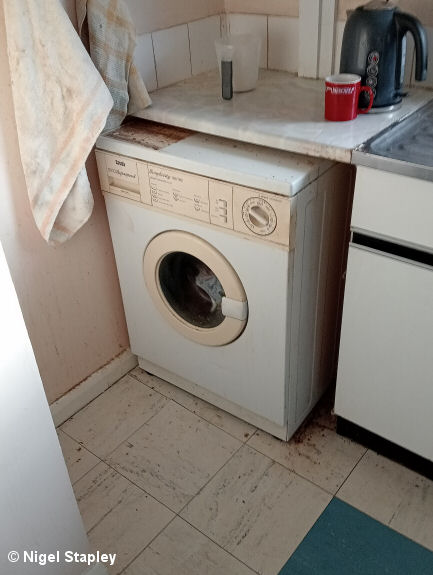
This is (or more likely by the time you read this, this was) a Creda 1000 Supaspeed. It dates from 1994, and I can be certain of that because I still have the receipt from a local white-goods emporium now long gone:
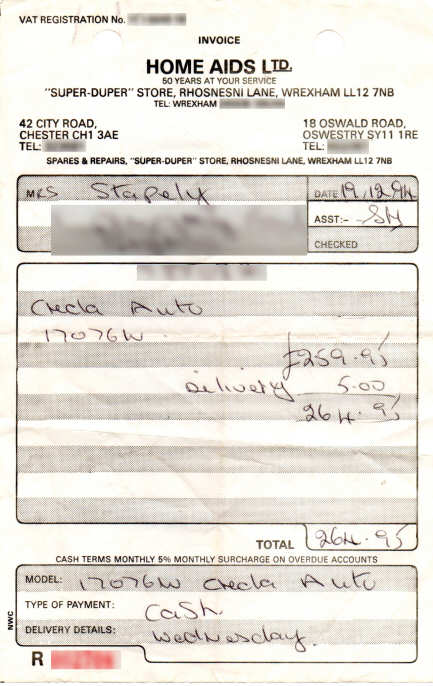
Thirty-one years is pretty good going, you have to admit. In all that time, it only needed four call-outs. The first was sometime in the nineties to replace the control panel; the second was early in this century because the door handle snapped off; and the third occasion was in April last year when one of the inlet pipes sprang a leak.
For all that, the odds against it were becoming inevitably shorter, which is why I kept paying an annual insurance fee to cover the eventuality.
I got the most recent reminder in the post back in November. Before I'd even had the chance to act upon it, I got a phone call from the insurance company, so I bought another year at a cost approaching £300.
The old policy was due to run out on December 12. On December 11 - it being one of the rare nice, sunny days we had had - I decided that it was the ideal opportunity to get bedsheets, pillowcases, towels and flannels washed and out on the line. These all need a hot wash, so I duly loaded the Creda and set it going.
After about half an hour, I noticed that not a lot was happening. Usually, if it's being a bit quiet, I can put my ear to the rotary dial and hear it whirring away, presumably waiting for the incoming water to get to the required temperature before continuing on its merry way. No such sound was to be heard on this occasion. I tried waggling the dial, because it has been known to stick from time to time. No soap (or washing powder, for that matter).
Pondering my next move, for some reason I went over to the fridge and opened the door. No light. Hmmmm. The circuit fuse must have tripped out. I went to the fuseboard in what is grandiosely described as 'the cloakroom'. Yes, the fuse for the kitchen sockets had tripped out (and I hadn't been aware until that point that I even had a separate circuit for the kitchen). I tried to reset it; it immediately clicked out again. A second attempt produced the same result. Hmmmm redux.
I went back into the kitchen and turned the washing machine off at the wall. This time, the fuse did reset. Returning to the machine, I powered it back on again. It clicked and then did nothing more. The fridge light had gone out again. Once again switching the Creda off, I reset the fuse and considered my next move. The Creda was - if you'll excuse the technical term - completely shagged.
This left me with a problem beyond the obvious. As it had packed up part-way through a wash, there were now two bedsheets, two pillowcases, one bath towel, two smaller towels, a dishcloth and two face flannels stuck in there getting steeped in dirty and ever more tepid water.
Consulting the instruction book which came with it all those years ago, I found that the only way I could rescue my washing was by manually draining the machine, as the door wouldn't open so long as there was water in the drum. The waste pipe was, naturally, at the back of the beast, so I had to lummox the machine away from the wall far enough to be able to get to it and unhook it from the stand-pipe in the wall. I then had to find a receptacle for the open end of the pipe but, because the hose exited from the bottom of the machine, a bucket was no use because the lip of it would be too high. I therefore got out my washing-up bowl and dropped the open end into it. A small torrent of lukewarm (and somewhat niffy) water gushed into it. I had to make three passes at it before the machine was as near to empty as dammit.
I then tried to open the door. It wouldn't shift. Now what? Call in the repair bod, that's what. So I logged in to the insurer's website, grateful that this had happened the day before the insurance ran out (as these things tend far more often to happen the day after). I described the problem and logged the call. That was all I could do for the day. And, indeed, the week.
It was the following Monday (that's the fifteenth if you weren't keeping up) before the repair bloke turned up. Nice lad. I showed him the receipt, and he said his record was a thirty-eight-year-old dishwasher he'd recently had to minister to. Taking the top off the Creda, he noted that the control circuit was clogged up with dirt and fluff, and expressed doubt as to whether he could source a new one. Reaching down into the entrails of the beast, he managed to release the door catch so that I could at least retrieve my washing (although after he'd gone, I had to drain it again because he'd managed to get it to go long enough to start to fill without this knocking the fuse out again).
When I got it out, it was naturally wet and equally naturally minging because it had been in there for four days. I put it in the washing-up bowl and put that in a corner so that its mephitic pong wouldn't contaminate the place.
That was it until the following Saturday, when I got a text from the repairers saying that repairing it was something they couldn't do.
The next step was to order a new machine, because the insurance policy included a like-for-like replacement. I held back for a day or two before going back to the website, examining the machines on offer and choosing one. Christmas was now upon us, so there was no real possibility of delivery before everyone knocked off, so I asked for delivery on the Monday after (the 29th, if you're still keeping count).
Over the weekend prior to the new machine's arrival, I had disconnected the old one completely. Unplugging it was no problem (once I'd dragged it away from its nest again, of course) and disconnecting the hot and cold lines was simply a matter of turning off the little bath-like taps under the sink and unscrewing the hoses. Said hoses - along with the transport bracket which, like the receipt, I had never thrown away - were stashed inside the drum.
Monday morning arrived (as it tends to do if you hang around a bit), and shortly before ten a medium-sized white van turned up at the gate. This duly disgorged two men; one rotund and stocky, the other less so in either dimension. The new machine was unwrapped at the kerb and brought up the path and in through the back door (this being the easier option, what with there being only one step and not having to negotiate the treacherous narrows of the hall). The Creda was loaded onto the truck and wheeled out of the kitchen for the last time and out to the van.
(I'd had to pay for not only the delivery and installation of the new item, but also for the removal of the old one, destined for the delivery company's recycling plant).
I had my usual anthropomorphic feelings at this point, especially given the length of time that the old machine had been part of my life, along with its own unique sounds; one gets so used to these that they become part of the intimate domestic landscape, and things seem in some undefinable way 'wrong' when they're no longer there.
The stocky bloke connected up the machine to the cold water feed (no hot water pipe on this one), put the drainage hose into its holster on the back wall, manhandled the machine into position under the worktop and gave it a little test. He departed the scene with all apparently in good order...
...except...
...when putting the cleaning stuff back on the shelf under the sink, I noticed...water. Feeling up the cold-water pipe, I could tell that the pipe hadn't been properly connected to the little tap and was leaking. I cursed for a moment, but then realised that - having successfully disconnected the old pipe two days before - I was perfectly capable of tightening the new one properly myself. This I did, and left it a little while to see if my efforts had been successful. They had.
So, ladies and gentlemen, boys and girls, crocodiles and gentiles, I present to you the Beko BM3WT4841IW:
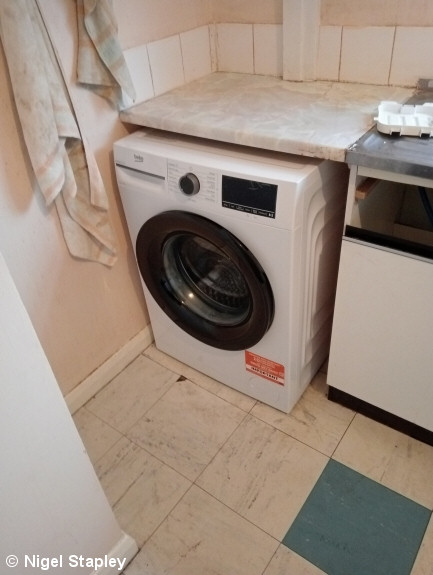
Not shown in this photograph is the 48-page instruction book which came with it. Having had various digits lightly singed down the years by trying to use a new piece of equipment without fully reading the bumf, I resolved to go through the booklet thoroughly before even thinking of using it.
Technology advances - or so we are led to believe - so that process of familiarisation took the rest of Monday, and at the end of it I still couldn't quite be sure that I had understood it all. Simply comprehending the control panel and its multifarious capabilities made me wonder whether I needed to gain extra qualifications to avoid making a complete mess of things.
There seemed to be so many options. The Beko has at least fourteen different programs for a variety of fabrics, temperatures and spin speeds, most of which I will almost certainly never use or need. My custom with the Creda had been just to put everything in on 40° and let it ride (except when I was washing the bed-clothes and towels, in which case 90° was preferred).
Where to begin? Well, the booklet said that before first use I should use the programme marked 'Drum Clean'. So on Tuesday morning I powered it up, made the selection and pressed 'Go'. Somewhat to my dismay, it then proceeded to carry out what appeared to be a full 60° wash without either clothes or powder in it. After about an hour of its aimless sloshing about, I found the paragraphs which told me how to cancel a programme in mid-operation.
Well, I bethought myself, at least the drum should be clean now. So it was time for the real first test. The half-washed bed-clothes and towels were still stinking quietly away in the bowl, so those were first. They all fitted in the old machine comfortably enough, but I was very wary of doing the same with the Beko, thinking that running it in (rather in the manner of motor cars of the pre-1980s period, where you would see a sticker on the rear window saying, "Running In, Please Pass") was the wiser option. So I did a first run with just the sheets and pillowcases, set the machine to 'Cottons' and '60', and let the beast loose.
This machine is a lot quieter than its predecessor, so much so that I had to listen carefully from the living room to check if it was actually going or not, even going into the kitchen from time to time when the paranoic anxiety proved to be overwhelming. It also takes a lot longer then the Creda; whereas a hot wash of this sort would be done in about an hour and a half, this one takes at least an hour longer than that (it has a countdown clock, which is informative and irritating in roughly equal measure). In fact, everything takes longer on this one; even the spin cycle lasts for fifteen minutes.
Batch One emerged from this process clean but still pretty damp (I hadn't discovered the 'Spin & Drain' programme at that point) and this - as the weather was no longer amenable to putting it out on the line - was draped over the airing rack behind the kitchen door (in the case of the sheets) or on the rack over the hall radiator (in the case of the case of pillows). The towels and flannels were then loaded and Beko (would it be bad taste if I nicknamed it 'Steve'?) took it from there, and the 'output' hung on the airing rack.
This first test having been passed satisfactorily, I felt it safe to report my satisfaction to the insurance company's Trustpilot page, but nonetheless including my remarks about the leaky connection.
The next day, I loaded - once again in two batches for the same reason as before - three weeks' worth of dirty clothes, with satisfactory results.
So there we are. The thought did occur to me that all the money I'd paid in insurance premiums down the last couple of decades or more would have enabled me to have a washing machine in every room, but that's the risk you take, I suppose. The insurance on the new one is only some seventy-odd pounds a year rather than the near three-hundred for the old one, so I suppose this counts as a win for prudence. It should certainly see me out, although I thought that about the fridge-freezer I bought in 2014 to replace one which had seen a similar length of service.
But, for the time being at least, I've cleaned up.


